
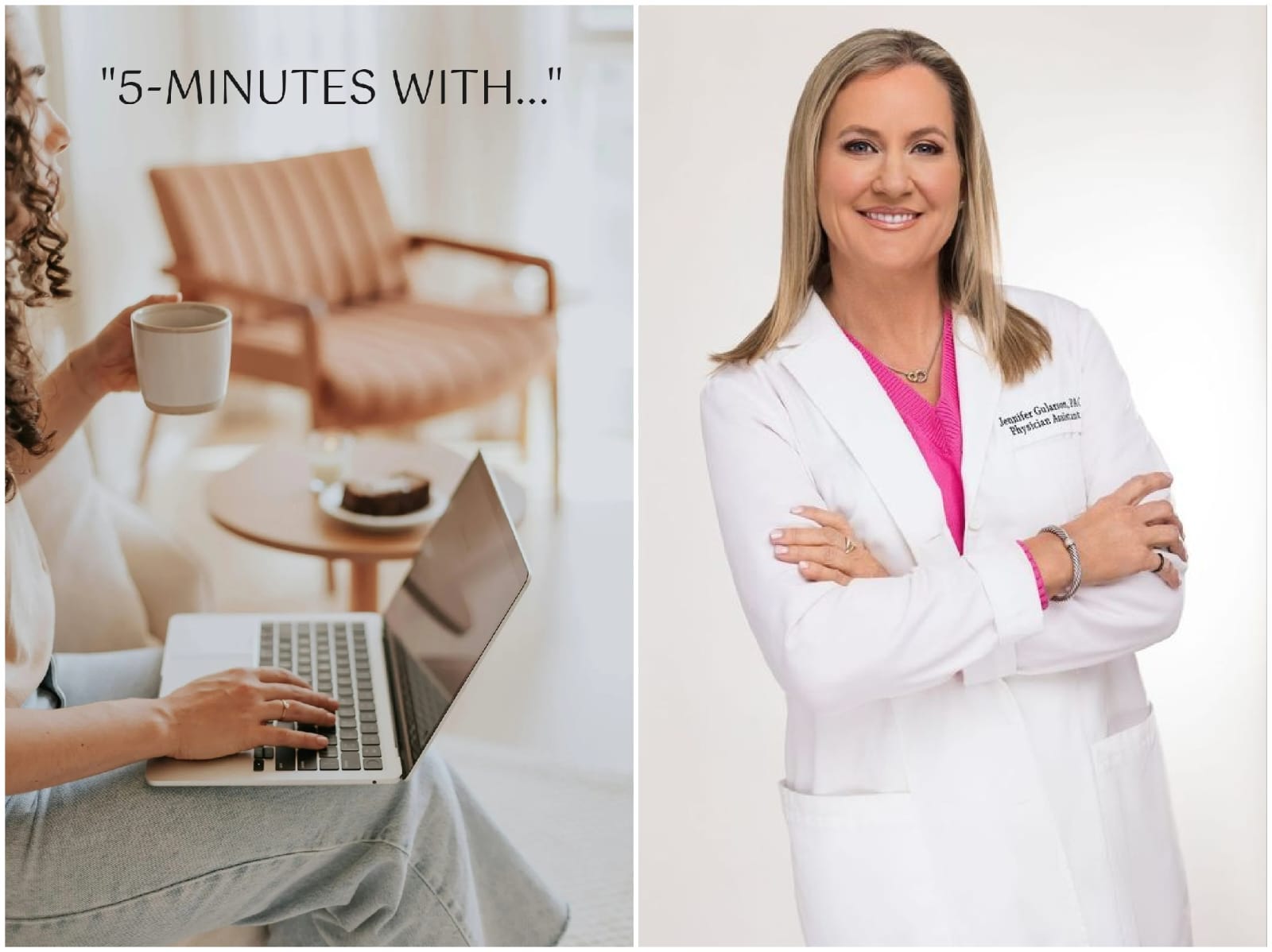
Jennifer Gularson is a Physician Assistant specialising in functional and integrative medicine, with a particular focus on hormone replacement and women’s health, and she’s also a woman living the exact transition she supports others through. She’s an empty nester now, which she describes as surreal and deeply empowering: her 30s were devoted to raising good humans, her 40s were about launching them into the world, and now she’s finally turning inward. In this ‘5-minutes with…’ conversation, Jennifer speaks with refreshing honesty about how even as a menopause specialist, she underestimated her own symptoms and normalised creeping weight gain, brain fog, and libido shifts for far too long. When she added oestrogen therapy (alongside progesterone and testosterone), the change wasn’t cosmetic, it was foundational: clarity returned, metabolism stabilised, desire came back, and she felt like herself again. Her core message is simple and potent: suffering in silence is not a rite of passage.
Who are you, and what season of midlife are you in right now?
I am a Physician Assistant specialising in functional and integrative medicine, specialising in hormone replacement, and a passionate advocate for women navigating midlife with power rather than fear, and I am absolutely in the thick of midlife, and I’m loving it!
I’m officially an empty nester, which feels both surreal and deeply empowering. My 30s were devoted to raising good humans. My 40s were about launching those incredible humans into the world. And now? Now I have the luxury of turning inward.
This season is about rediscovery, it’s about asking:
Who am I now?
What do I want?
What energises me? What are my passions?
For the first time in decades, I have the space to focus on myself. This includes my health, my personal growth, my career, and, excitingly, experiencing new things. Midlife for me isn’t winding down; it is about reigniting and finding my passions.
What surprised you most about midlife or menopause?
What surprised me most is even as a healthcare provider deeply immersed in menopause care, I still underestimated my own symptoms.
I’ve been preparing for menopause for over a decade. I work in this space. I lecture and educate others about it. I encourage women to be proactive. I truly try to practice what I preach. And yet, when I look back at my 40s, I realise how many of my “frustrations” were actually hormonal shifts.
The creeping weight gain didn’t respond to the same strategies. The brain fog made me question myself. The quiet fading of libido felt confusing and uncharacteristic. I normalised a lot of it.
When I finally started estrogen therapy (I was already using Progesterone and Testosterone), the shift was profound. My clarity returned. My metabolism stabilised. My desire came back. It wasn’t about vanity; it was about vitality. What surprised me most wasn’t that hormones helped. It was how much better I could have felt sooner. That realisation deepened my commitment to helping women recognise symptoms earlier, advocate for themselves, and understand that suffering in silence is not a rite of passage into midlife.
What’s been the hardest part that people don’t talk about?
From my perspective as a healthcare provider and as a woman in midlife, the hardest part that people don’t talk about or are afraid to voice is the mental impact of perimenopause and menopause.
We talk about hot flashes, we talk about weight gain, but we don’t talk nearly enough about the cognitive and emotional toll. I experienced it myself: walking into a room and forgetting why I was there, struggling with word retrieval, losing names mid-sentence, and feeling my motivation dip in a way that felt foreign to me.
For high-achieving women, especially, this can be terrifying. In my practice, I see women recording meetings so they don’t miss details. Covering their desks in Post-it notes, double-checking emails repeatedly before sending them. Quietly wondering: Is something wrong with me? Am I slipping? Could I lose my job? The fear isn’t dramatic; it’s subtle and persistent. And it’s rarely spoken out loud.
The other deeply unspoken struggle is what has been called the “quiet quitting” of relationships. Not because women don’t love their partners. But because of hormonal shifts, vaginal discomfort, decreased libido, stress, and lack of support, intimacy can begin to feel complicated… or exhausting. Many women feel resigned, as though a downturn in their physical relationship is simply the price of ageing.
It’s discussed in whispers, if at all, among girlfriends. But in my exam room, I hear the grief, the confusion and the sense of loss. What breaks my heart is that so many women believe this is just how it is now. It doesn’t have to be
What has helped you most (a habit, a mindset shift, support, HRT or no HRT, community)?
For me, the most powerful shift started with understanding why this was happening. For most women, knowledge removes fear.
When you understand that the brain fog, sleep disruption, weight gain, and mood shifts are all rooted in hormonal changes, you can stop internalising them as personal failures. You can also stop thinking you’re the only one.
Normalising the experience is incredibly empowering. In my office, I see accomplished, intelligent women whisper their symptoms as though they’re uniquely broken. The moment they realise they’re not alone, you can almost see their shoulders drop. Tears of relief flow because they are finally being heard and validated.
Hormone therapy has played the most important role for me personally. It gave me back the foundation on which functional medicine is built: sleep, clarity, energy, and drive. And once that foundation was restored, I could implement the lifestyle changes that truly sustain long-term health. I could lift weights consistently, stay active without feeling depleted, and I could think clearly enough to lead at work. Hormones weren’t the whole solution, but they made the rest possible.
And then there’s community. My community is amazing and diverse, and it is everything to me. Finding like-minded practitioners to collaborate with in patient care has been invaluable. But even more importantly, I’ve built what's been called my “MenoPosse”. This is a circle of women who support each other without judgment, who can say, “Is this happening to you too?” and be met with understanding instead of dismissal.
Midlife can feel isolating if you try to navigate it alone. It becomes expansive when you find your people. Community changes everything.
What are you unlearning?
Growing up as a competitive athlete, I was conditioned to push through and perform. To carry responsibility without hesitation. Stepping back wasn’t part of the training. That mindset served me well for decades. As a mother of three, a wife, a daughter, a friend, and a healthcare provider, I became very good at being everything to everyone.
What I’m unlearning now is the belief that I am responsible for everything and everyone. Midlife has asked me to examine where my energy goes. To be more intentional, and yes, a little more selfish. That word used to feel uncomfortable. Now it feels necessary, my therapist asked me to change my word from selfish to self-love. I am trying!!
Choosing who and what gets my energy is a stark shift from the years of constant output. Sometimes it looks like saying no to invitations, projects, or relationships that don’t align with how I want to feel or where I see myself going next. I’m learning to trust my intuition instead of overexplaining my decisions. I’m learning to make choices for myself, even if they disappoint someone else. This is not always easy and sometimes really uncomfortable, but it is growth for me.
Perhaps most importantly, I’m learning that protecting my peace isn’t weakness, it’s wisdom.
What do you wish you could tell your 35-year-old self?
I would tell her that Life is so busy right now, and that’s normal. You’re juggling motherhood, marriage, career, expectations, and a never-ending to-do list. Some days you’re barely keeping your head above water, and you quietly wonder if you’re doing any of it well. I would reassure her that she is enough and is doing a great job.
I would tell her it’s okay not to be 100% everything to everyone. Taking time for yourself is not selfish; it’s necessary. You don’t have to earn rest, and you don’t have to justify caring for your own body and mind.
I would reassure her that she’s going to get through this season and be incredibly proud of what she's built. A woman is waiting on the other side of this intensity. A woman with more clarity, more confidence and more space. A woman ready to flourish and keep growing.
“The days are long, but the years are short” is more than an adage; it’s the truth. The day-to-day can feel overwhelming, and in that overwhelm, it’s easy to lose yourself a little, but you will get back to yourself.
I would also say: don’t sweat the small stuff. If your daughter wants to wear the same dress for two months straight, let her. If your son wants a mohawk, have at it. If your family hates the dinner you just made, they won't starve; breakfast is in a couple of hours. Choose your battles wisely. It’s okay for your children to feel uncomfortable sometimes. Life is uncomfortable at times, and that’s where growth happens. And for you? Growth is happening too, even when you can’t see it yet.
What do you want other women to know they’re not alone in?
Every woman will experience some form of perimenopausal or menopausal transition. Every single one. For some, the symptoms are obvious and in-your-face: hot flashes, disrupted sleep, mood shifts. For others, they’re subtle: a creeping anxiety, joint aches, loss of motivation, changes in confidence or desire. Some shifts are so gradual you barely notice until you look back. Every journey is different. But every journey is valid. Let’s hold space for that.
What you are feeling is real. It is not “all in your head.” You do not have to accept dismissal as the final word. If you feel unheard, keep looking. Find someone who will listen, explain what’s happening physiologically, and offer reassurance and options. It may take time to fine-tune what works for you, but this experience is very, very real.
It is also okay to talk about it. There is hope. There are solutions. This is not our mothers’ menopause. We are learning more every year about brain health, bone health, cardiovascular protection, sexual wellness, and hormone therapy. The narrative and treatment options are changing. Ask questions. Stay curious. Share your experience. Find your community. You are not alone, and you were never meant to navigate this on your own.
What’s one small ritual or practice that’s keeping you steady in your daily life?
Every morning, I walk my dog. Thea’s enthusiasm for the day, the wagging tail, the eager eyes, the absolute joy over something as simple as a walk just sets the tone before my feet even hit the floor.
I love having a reason to get up. Someone offering unconditional affection (and enthusiastic face licks if I don’t move quickly enough). There’s something incredibly grounding about beginning the day with that kind of pure presence.
Stepping outside, feeling the morning air, letting sunlight into my eyes, and moving my muscles before the world starts demanding things of me make a profound difference. I often walk through the woods near my home, and that quiet time with no notifications, no conversations, just contemplation really steadies me. It’s simple. But it’s powerful.
That daily ritual reminds me to start the day with movement, gratitude, and perspective. And honestly, I’m deeply thankful for her persistence because even on the mornings I don’t feel like jumping out of bed, she makes sure I do. And it always makes the day better, Portuguese Water Dogs will do that!
What stayed with me most in Jennifer’s answers is the way she names the quiet fear so many women carry but rarely admit: the mental impact. Forgetting words mid-sentence, double-checking everything, wondering if you’re slipping, worried you’ll lose your edge or your job. And then the other whisper-topic: the quiet quitting of intimacy, not because love disappears, but because hormones, discomfort, stress, and a lack of support can make connection feel complicated. Jennifer brings compassion to both and offers options. Knowledge removes fear. Validation changes everything. And hormone therapy, for her, wasn’t the whole solution, but it made the rest of the solution possible: strength training, movement, energy, sleep, and the capacity to lead. I also love her emphasis on community, her MenoPosse, and the reminder that every woman’s journey is different and still valid. If you feel unheard, keep looking. If you feel dismissed, don’t stop. There is hope, there are solutions, and this chapter can be expansive with the right support. And if you need a gentle nudge to start your day well, borrow Jennifer’s ritual: step outside, let the morning air meet your face, follow the dog’s joy, and remember you’re allowed to take up space in your own life again.
This series exists because when one woman tells the truth, another woman exhales. If something in this conversation made you exhale, if you recognised yourself in her words, there is a space where that feeling has a home.
The Midlife Circle is where the deeper conversation lives. Not just other women’s stories, but yours. Bi-weekly essays and The Midlife Edit, a private podcast, tools across all five areas of this season of life, from £19/month or £149/year.
And if you’re ready to go all the way in, the Midlife Inner Circle at £297/year includes the Midlife Manifesto Audio Training, The Midlife Reset course, and four quarterly 1:1 calls with me. Real, personal support for the redesign you’re already beginning.
So grateful you shared your story. Taking time to understand what is happening and giving that space is so important. This is reassuring when so much of the information creates more fear.
So grateful more and more women are willing to share their stories. What a beautiful tale of one’s walk-through menopause. 🙏🏼
Each one of us has such a different journey, and every story shared makes a positive difference— bringing light to another. ♥️