
There’s a particular kind of midlife that doesn’t always get romanticised, not the dramatic reinvention, not the glossy version of starting over with perfect lighting and a clear five-year plan, but the quieter, more honest version. The one that happens at the kitchen table, in between school runs, packed lunches, shifting algorithms, changing hormones, and the slow realisation that the way you used to do life no longer works in the same way.
That’s what I felt reading Lena Mintz’s answers. She runs a small online business called Mr Mintz, creating digital craft templates for children, and six years ago, she left corporate life to build something of her own from home. What I loved most about her answers is that they feel so grounded in the reality of modern midlife. Children still need you. Business models are changing. Technology is moving fast. Your body is quietly refusing to be managed the way it once was. And in the middle of all that, the work of trying to build a life that is both sustainable and true.
There’s something deeply relatable in the way she speaks about this season not as arrival, but as reassembly. Because that’s often what midlife is, isn’t it? Not becoming someone unrecognisable, but gathering the pieces again with more honesty: keeping what still fits, reworking what doesn’t, building from lived experience rather than fantasy.
And maybe that’s what stayed with me most here: the sense that this decade is not about coasting, it’s about staying awake, staying adaptable, staying willing to rebuild when life, business, motherhood, and your own body all start asking different things of you.
What stayed with me most was her description of no longer treating exhaustion as proof that she was working hard enough. That landed.
Because so many women, especially women building something while also holding family life together, have been conditioned to wear depletion like evidence. Evidence that we care, evidence that we’re committed, evidence that we’re doing enough. But there comes a point where exhaustion stops being a badge and starts being a cost.
I also loved her idea of choosing a longer rhythm, not the endless sprint, not the adrenaline-fuelled version of success, but something steadier. More sustainable, more honest about what the body can handle and what real life actually requires. That feels deeply wise to me.
And then there was the image that stayed with me most: a woman sitting in the dark in 2020, everyone else asleep, writing two columns on a piece of paper: reasons to go back, reasons not to, no grand performance, no dramatic speech, just one quiet decision that changed everything.
That’s the kind of moment I think midlife is full of. The decisions that don’t look cinematic at the time, but end up shaping the whole next chapter.
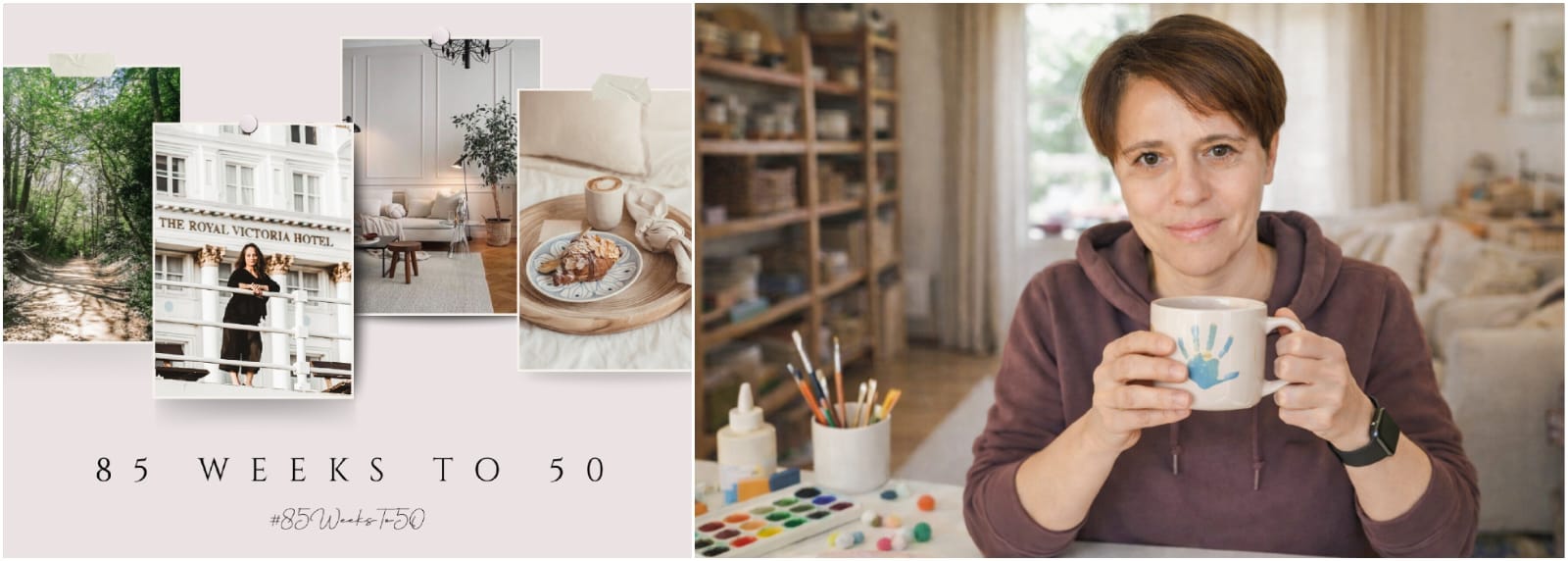
Who are you, and what season of life are you in?
I’m Lena, and I run a small online business called Mr Mintz. We create digital craft templates for young kids.
I turned 50 last year. That number doesn’t quite match how I feel inside, especially when your children are 8 and 12 and need you in very everyday ways.
Six years ago, I left a corporate job and started building this business from my kitchen table. Digital products, no inventory, no shipping, it felt like a solid plan. And for a while it was. But now the rules are shifting again: AI, search algorithms, the way people find and buy things online. What felt stable suddenly needs rethinking.
So I’d say I’m in a season of reassembly. Less about arriving somewhere, more about figuring out what the next version looks like.
What surprised you most about your 50s?
The body. Not in some dramatic way, more in a quiet, non-negotiable way where it starts setting its own terms. Little sleep, running on stress and adrenaline, that used to work. It doesn’t anymore.
That was the biggest surprise: realising that if I want to stay sharp and present in my own life, I have to take care of myself on purpose. Not as self-care theatre, but as a practical decision.
The other surprise is that 50 turned out to be nothing like the faraway, narrowing age I once imagined. It feels entirely possible to rebuild a business, pick up new interests, and start over. You just have to be more honest about what your body and mind actually need along the way.
One thing you’ve stopped doing (and you’re better for it):
Treating exhaustion as proof that I’m working hard enough. For years, I built things late at night; it was the only time the house was quiet, and I could think. I haven’t turned into someone who wakes up at 5 a.m. and feels amazing. But I’ve stopped believing that pushing past the point of real fatigue is an achievement.
I can feel now when I’ve crossed the line from productive to useless. At that point, it makes more sense to close the laptop than to keep pretending.
One thing you’re choosing instead:
A longer rhythm. I used to live in a kind of endless sprint, everything urgent, everything now. I’m trying to work more like a long-distance runner: serious and consistent, but not built on fumes.
And the funny thing is, it’s more productive. When I’m depleted, I work slowly and make mistakes that I have to fix the next day. When I’m rested, I do more in less time, and I do it better.
Underneath that, I’m also choosing my family more deliberately. The work matters, but it doesn’t get to take everything first.
One boundary you now honour, no apology:
My time, and where it goes. I don’t say yes out of obligation anymore. Not to work that drains me, not to conversations that leave me empty, not to dynamics built on pressure or unnecessary control. I used to tolerate all of that. Now I don’t.
It’s not about being strict. I’ve just become calmer about what I want to be part of, and what I don’t. My kids are 8 and 11. That window of them actually wanting to be around me is not that long, and I’m choosing to protect it.
One micro-decision that changed everything:
One sentence I finally admitted to myself: I’m not going back. It was 2020. My maternity leave was ending, and the sensible plan was obvious: a serious corporate job in a large IT company, a stable salary, and two small children. Walking away in the middle of a pandemic felt almost irresponsible.
I sat down one night with a sheet of paper and two columns: reasons to go back, reasons not to. I wasn’t thinking about purpose or reinvention. I was thinking about rent and kindergarten fees. But somewhere in those lists, one thing became clear: if I went back, I’d be choosing safety over a life that actually felt possible.
That decision led to my Etsy shop, then to my website, then to everything that came after. At the time, it felt like a leap into nowhere. Looking back, it was just one quiet choice made after everyone else had gone to sleep.
One practice that keeps you steady:
Routine, mostly built around my kids. Getting them to school, packing lunches, cooking. All of that creates a structure that holds the day together, even when everything else feels uncertain.
Cooking helps the most, oddly enough. It’s repetitive, physical, and predictable. You follow the steps, and something real comes out of it. That kind of grounded, almost automatic action brings me back faster than anything abstract. Sometimes it’s even simpler, just a cup of coffee in silence.
One belief about midlife you no longer subscribe to:
By 50, the structure is built, and you mostly maintain what you have. The opposite turned out to be true. The world doesn’t slow down just because you’ve reached a certain age. If anything, you need to learn and adapt faster than before. AI alone has completely reshuffled what’s possible for a small business; tools that once belonged to large companies are now on my laptop. That’s exciting, but it also means what I built yesterday may not work tomorrow.
So the belief I’ve let go of is that midlife is about coasting. For me, it’s been about staying in motion and being willing to rebuild.
The best thing about being in your 50s:
Internal freedom. My life is full, the responsibilities are real, but inside, there’s a clarity I didn’t have before. I know much faster now what feels like mine and what doesn’t. I don’t waste energy trying to fit into things that weren’t made for me.
And I haven’t become quieter in the sense of wanting less. New technologies genuinely excite me. I love starting things. I get that feeling of “Wait, this is incredible” more often than you’d expect at this age.
Less need for approval, more honesty with myself, and a real appetite for what’s next. That’s the best part.
At 50+, I am…
… the woman who sat in the dark with a sheet of paper chose the scarier column, and would do it again.
My Note to My Future Self
What I love about Lena’s answers is how ordinary and extraordinary they feel at the same time. Ordinary in the sense that they are rooted in real life: children, cooking, coffee, work, fatigue, uncertainty, the small domestic structures that hold a day together. But extraordinary in the sense that she has chosen to keep listening to herself inside all of it: to keep adapting, to keep building, to keep saying yes to what feels more alive, even when it’s less guaranteed.
That line about internal freedom really stayed with me, too. Because maybe that is one of the greatest gifts of this decade. Not a life without responsibility, but a life with more honesty inside it: less performing, less trying to squeeze yourself into shapes that were never designed for you. More clarity about what feels like yours.
And maybe that’s the real reinvention, not becoming someone else, but becoming more deeply loyal to yourself.
If you’re following along this week
My Stop: Where am I still treating exhaustion as proof that I’m doing enough?
My Start: What would a longer, steadier rhythm look like in my life right now?
My Boundary: Where do I need to protect my time and energy more deliberately?
My Micro-decision: What quiet choice have I already made in my heart that I now need to honour in real life?
My Practice: What simple, grounding routine helps bring me back to myself?
Journal prompt: Where in my life am I being asked not to coast, but to reassemble and rebuild more truthfully?
If you’d like to be part of the ‘85 Weeks to Fifty' series, or you know a woman whose voice would feel like medicine here, email me at hello@kiransinghuk.com. And if you’re reading this thinking, same, tell me in the comments: What is your takeaway from this interview?
Kiran, you read these answers more generously than I wrote them. The exhaustion line was the one I almost cut. It felt too much like admitting defeat, so seeing you pull it out as the thing that stayed with you did something for me. And that line of yours about loyalty to yourself being the real reinvention — I'll be sitting with that one for a while. Thank you for the series.