
Your home is not just where you dump your bags and your to-do lists at the end of the day, it’s the first place your nervous system reads when you cross the threshold. Before you’ve even taken your shoes off, some quiet part of you is asking:
Do I soften here? Or do I brace?
I didn’t always know that. For a long time, I treated home like a project: something to organise, decorate, and keep “presentable”. I thought cushions and colour schemes were just about style. Now, in midlife, I know they are about survival, about nervous-system safety, about creating a space that holds you when the world outside is loud, and your hormones are doing cartwheels.
These days, I call it designing for the soul. Science calls it “neuroaesthetics,” but I promise you, you already know what it feels like in your bones. It’s that exhale you do when you walk into a room that just feels right, without being able to explain why.
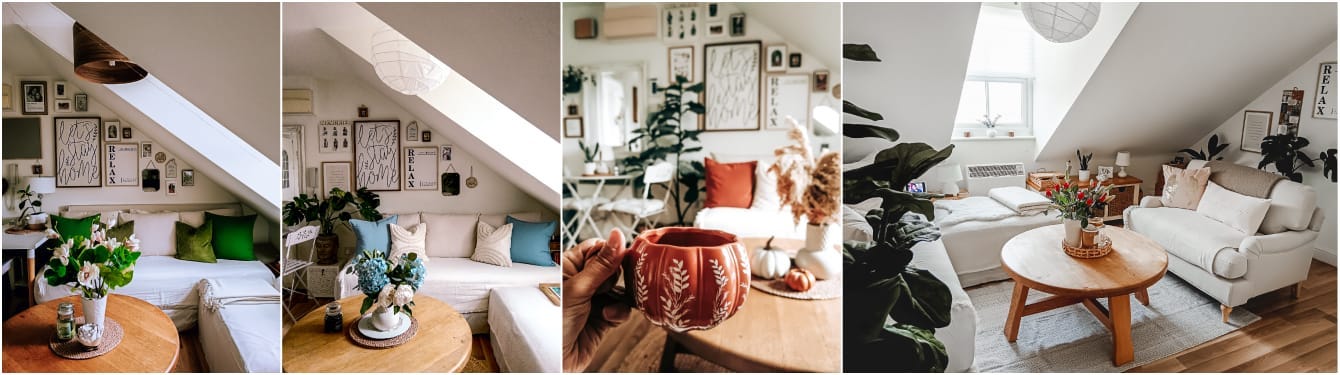
For me, it starts with the seasons. I style our home the way I style my life: in dialogue with winter, spring, summer and autumn. When winter comes, I don’t just pull out a thicker duvet. I lean into candlelight, softer lamps, rich textures, deeper colours, and slower corners. When spring arrives, I clear surfaces, let in more light, bring in fresh flowers, and swap heavier textiles for lighter ones. Summer asks for airiness, breeziness, open windows, bowls of fruit, and lighter scents. Autumn calls for warmth again, terracotta mugs, amber glass, burnt orange colour themse, cosy throws, little rituals that invite you to linger.
The house shifts with the season because I shift with the season. I need different kinds of holding at different times of the year. My home has become a mirror for that.
A home becomes truly alive when it holds your life.
What I didn’t realise until much later is that there’s a whole science behind this. Our nervous systems are constantly scanning our surroundings, a subconscious process that decides, “Am I safe? Or do I need to stay on guard?” Harsh overhead lighting, piles of clutter, echoey rooms with hard surfaces… they all whisper “stay alert” to the body, even if your brain is insisting, “I’m fine, everything’s fine.” You’re not having a random bad day. Your environment is talking to your nervous system.
Let me give you an example from my own kitchen.
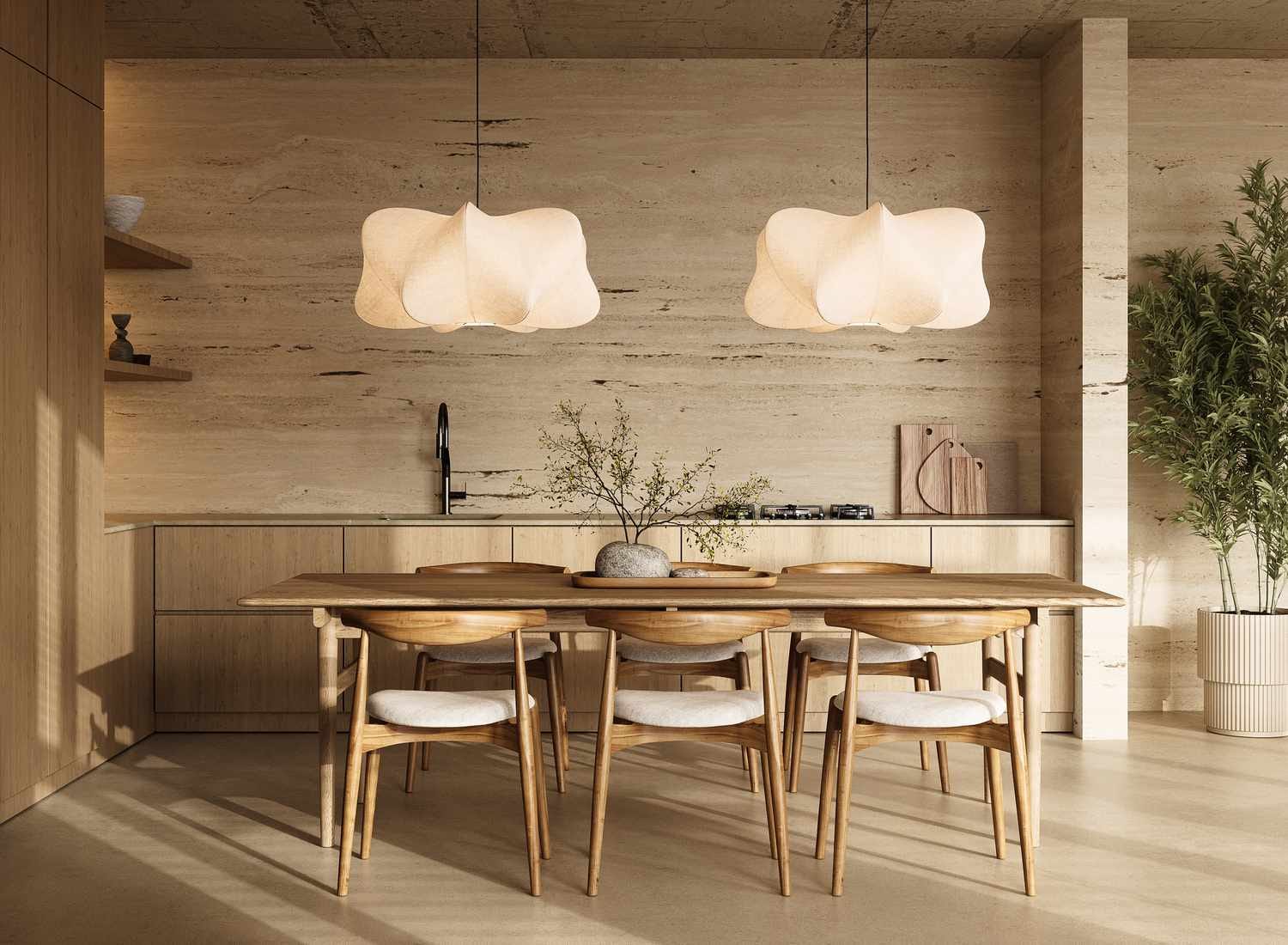
For a long time, my kitchen was pure function. Hard surfaces, strong lighting, everything practical, nothing particularly soft. It did the job. But I noticed something strange: I felt more irritated in that room than anywhere else in the house. I’d go in to cook and feel my shoulders creep up towards my ears. The to-do list in my head would get louder. I’d rush through meals instead of enjoying them.
One day, I caught myself standing in the middle of the kitchen thinking, “No wonder I can’t relax in here. There’s nowhere for my body to land.”
So I started small: A linen tea towel here, a woven basket there, a wooden chopping board was left out instead of hidden away. I put a small runner on the floor to soften the sound of my footsteps. I turned off the main overhead light in the evening and used warm lamps and the oven glow instead. It wasn’t a full renovation. It was a sensory shift.
The room didn’t just look different, it felt different: I noticed I moved more slowly, I put music on while I cooked, and I enjoyed hovering over a simmering pot instead of racing to get it done. My body finally got the message: “You can soften here. You don’t have to be on duty.”
That’s what I mean by signals of softness. They don’t have to be expensive or dramatic; they just need to tell your nervous system: “You’re not on a battlefield. You’re home.”
Another thing our bodies love? Predictability. Think about the tiny rituals that already regulate you, without you even naming them: the first sip of your morning tea, the lamp you switch on every evening, the way you tuck yourself into bed in a certain order, skincare, lip balm, book on the nightstand.
Those are not just habits; they are tiny messages to your body: “We’ve been here before. You know what happens next. You’re safe.”
When I wake up on a winter morning, I always start the same way: warm drink, blinds half-open to let in just enough light, a specific candle on the table, my journal waiting. It’s not aesthetic for the sake of Instagram, it’s a sequence my nervous system recognises. Before I’ve written a single word, my body has already started to shift from “on guard” to “I can land.”
The same thing happens at night. There’s a point in the evening where I’ll dim the main lights, turn on warm lamps, and put my phone away. I might fold a blanket over the sofa, light something that smells like cedar or vanilla, and slip into soft pyjamas. My brain might still be spinning, but my body is watching the cues and slowly exhaling: “Oh, we’re doing the night-time thing. I know this. I can start letting go.”
That’s the magic of ritual; it’s not about perfection, it’s about offering your nervous system a pattern it can trust.
And then there’s nature, our oldest cue of safety. Most of human history wasn’t spent under LED lighting, staring at screens. We lived with sunlight, shadows, trees, water, fire, and earthy smells. Our bodies remember that, even if our diaries don’t.

You see this in how different a room feels when you add a plant, or how your whole mood changes when you can see the sky from where you sit. In winter, when everything outside feels bare and grey, I’ll bring nature indoors on purpose: a little bathroom plant, eucalyptus hanging in the shower, earthy colours like deep green and terracotta in cushions or mugs. In summer, it’s lighter, flowers on the table, bowls of lemons, open windows, wind chimes, anything that lets the outside world in gently.
I don’t do this because some magazine told me to. I do it because my body feels the difference between a space that mimics nature and a space that feels clinical and flat. One calms me, one drains me.
But here’s something I had to learn the hard way: calm is not the only goal.
Midlife can easily become functional: get through the day, manage the symptoms, answer the emails, do the appointments, and collapse. Repeat. If we’re not careful, our homes become a mirror of that: tidy, practical… emotionally flat.
Regulation isn’t just about being calm. It’s also about feeling alive. So I started asking myself: “Where in our home do I feel a spark of joy, not just relief?”
For me, it’s in the little playful touches: the perfectly shaped mug that makes me smile every time I reach for it, the slightly kitschy candle holder reminds me of a market I wandered through years ago, the old wall-hanging my mum embroidered that lives on my sidetable during the colder months purely because it reminds me of my childhood, the photo of a ridiculous moment that still makes me laugh.
These things don’t “match”; they’re not curated, but they wake something up in me. I even have what I secretly call my “just because” box, a few postcards, notebooks, pens, small things that invite me to doodle, jot, daydream instead of scroll. It’s not productivity, it’s a play. And play is a nervous-system regulator too.
Styling our home with the seasons, adding softness to hard rooms, choosing lamps over harsh lights, bringing in nature, leaving room for play, none of this is about perfection. I still have messy corners, I still have days where the sink is full, and the cushions are not plumped and neatly placed, and nothing smells like cedar; it just smells like… life, but underneath that, there’s an intention: this house is allowed to hold me, too.
Your home doesn’t have to look like anyone else’s to feel regulating; it doesn’t need a name or a mood board. What it needs is your attention, your honesty and your willingness to ask:
“Does this space make my nervous system soften… or brace? Do I feel more like myself here… or less?”
From there, you can begin: one lamp, one plant, one cleared surface, one soft thing in a hard room, one tiny ritual at the same time every day.
Think of your nervous system as a tuning fork and your home as the room it vibrates in. If the room is full of harsh light, noise and clutter, the fork will hum with agitation, even on good days. But when you start to add softness, nature, predictability, play… You quietly retune the entire space.
You don’t have to get it perfect, you just have to keep asking, season by season:
“How can I make this home a place where my body and soul feel welcome?”
That’s designing for the soul. And that, my Love, is where science and art, and your midlife wisdom, finally meet.
Member Content: Your Soul-Led Home, Your Calmer Nervous System
What follows is where we take everything from the free post, seasons, softness, safety, aliveness, and turn it into actual steps, rituals and prompts.
Inside this member version, we’ll walk through:
A Nervous System Home Walk-Through so you can feel, not guess, what’s working and what isn’t
A One-Room Reset Ritual you can repeat in any space
A simple Seasonal Styling Framework for your home (that doesn’t require buying a single new thing)
Three Daily Home Rituals that signal “you’re safe” to your body
A 7-Day Gentle Home Practice to slowly shift the energy of your space
Journaling prompts and tiny embodiment practices along the way
No “forever home” fantasy, no renovation budgets, just you, your current home, and honest, loving adjustments. Let’s begin x
1. The Nervous System Home Walk-Through
We’re going to walk through your home the way your body already does, but consciously.
Set aside 15–20 minutes when the house is relatively quiet. Take a small notebook or your Notes app.
You’re not judging the décor. You’re noticing how your body feels in each space.
Start at your front door. As you stand there, ask yourself:
“When I step into this space, do I soften… or do I brace?”
Then slowly move through your home, entrance, kitchen, living area, bathroom, bedroom, and in each space, notice:
What happens in my shoulders?
What happens to my breath?
Does my jaw loosen or tighten?
Do my eyes feel rested… or overstimulated?
In your notebook, write the name of each space and a simple word or two:
Entrance: tight, cluttered, rushing energy
Kitchen: loud, hard, always “doing” here
Living room: softer, calmer, cosy corner by the lamp
Bedroom: mixed, peaceful bed, but chaotic bedside table
You’re mapping your body’s truth.
Journaling prompts
Once you’ve walked through, sit down somewhere that feels even slightly safe and reflect:
Which space in my home helps me breathe more deeply?
Which space makes me rush, brace or perform?
If my body could redesign one room first, which would it choose, and why?
Circle one room to start with. Not the “most embarrassing” one. The one that feels like it’s quietly asking for care. (For many midlife women, it’s the kitchen or the bedroom.) That’s the room we’ll work with in the next step.
2. The One-Room Nervous System Reset
We’re not doing a makeover. We’re doing a sensory edit. Choose your room, let’s say the bedroom for now, and give yourself an hour, max. Put some music on. This is not punishment, this is you tending to the place your nervous system sleeps.
Step 1: Clear one plane
Choose one surface or “plane” in the room:
your bedside table
the top of a chest of drawers
the chair that’s become a clothing mountain
the floor beside your bed
Your only job: return it to neutral, not Instagram-perfect, just: “I can see the surface. I can exhale when I look at it.”
As you clear, ask yourself:
“Is this object adding softness, safety or joy – or is it just sitting here because I haven’t decided?”
If it’s the latter, gently move it elsewhere for now; you can decide later. Today is about creating even one place for your eyes to land and your body to relax.
Step 2: Add one softness cue
Now, add something soft to that area.
It could be:
a small cloth or tray to corral what lives on your bedside
a folded throw at the bottom of your bed
a cushion in a fabric that invites touch
a pair of slippers placed where your feet land in the morning
You’re telling your body: “This room contains softness. It’s allowed.”
Step 3: Edit the light
Turn off your overhead light and just look at the room. Where could you swap glare for glow?
Maybe it’s:
a lamp on instead of the ceiling light
a warmer bulb
fairy lights on a shelf
a candle you actually burn, not just display
Try this: stand in your bedroom in the evening with only your “soft lights” on and notice how your nervous system responds. Do you feel slightly more like climbing into bed instead of scrolling on the sofa? That’s the point.
Step 4: Invite a nature cue
Add one small nod to nature:
a small plant
a vase or jar with a few stems (they can be dried, or from your garden, or even from the supermarket)
a stone, shell or piece of wood that feels grounding
a print or photo of a place in nature you love
Your body recognises these things even if your mind doesn’t register why.
Step 5: Anchor a ritual
Now ask:
“What do I want this room to say to me every time I enter?”
Maybe it’s: rest, soften, come back to yourself.
Choose one simple ritual that matches that intention:
putting your phone on aeroplane mode when you place it on your bedside
applying hand cream or oil before you read
placing tomorrow’s clothes gently on a chair instead of in a heap
Take three slow breaths before you pull the duvet over you
Write it down somewhere visible in the room: a sticky note, the back of your journal, a card on your bedside.
You’ve just created your first nervous-system-supportive room, not through perfection, but through tiny cues of safety and softness.
3. Styling by Season: A Simple Framework
In the free version, I shared how I style our home with the seasons. Here, I want to give you a little framework you can use again and again. Pick the season you’re in now and grab your journal.
Create four mini sections on a page:
Light
Textures
Colours
Rituals
Now answer, like you’re having coffee with yourself:
Light
Do I crave more light right now, or more dimness and cocooning?
Where could I let in more natural light during the day?
Where do I want softer, warmer light in the evenings?
Textures
Is my home asking for more softness (blankets, cushions, rugs) or more clarity and space (cleared surfaces, lighter fabrics)?
What one texture would feel like a treat to my nervous system this season? (linen in spring, wool in winter, cotton in summer, etc.)
Colours
What colours feel like this season in my body?
Where could I bring them in gently (mugs, cushions, throws, flowers, candles, art)?
Rituals
What is one ritual I want to be held by my home this season?
Winter: candle + book corner
Spring: a clear desk to dream and plan
Summer: a table inside or on the balcony, ready for light meals
Autumn: a cosy reading chair with a blanket
From your answers, choose one tiny adjustment per category and let that be your seasonal shift for now. You don’t need a whole new living room. You just need your home to be in conversation with the season you’re in – outside and inside.
4. Three Home Rituals That Tell Your Nervous System “You’re Safe”
We’re going to design three small but powerful rituals:
A front-door transition ritual
A kitchen landing ritual
A night-time nesting ritual
These are not chores. They’re cues: you’re home now, you can put something down.
1. Front-door transition
Most of us walk into our home and bring the entire day in with us, mentally, energetically, and emotionally.
Next time you arrive home, try this:
As you step inside, pause.
Put your hand on the wall, the door, a table, something solid.
Take one deep breath and silently say: “I’m home. I’m allowed to arrive.”
Then choose one tiny action that marks the transition:
Hanging your coat up instead of dropping it on a chair
Taking your shoes off and putting on something softer
Placing your keys in one specific bowl or spot
It seems insignificant, but over time, your nervous system will associate that sequence with “the outside world can wait a moment; you’re back in your space.”
2. Kitchen landing
The kitchen is often the most activating room. Let’s give it one moment of softness. Pick one time of day (morning or evening) and create a micro-ritual.
For example, in the evening:
Clear just the sink or one counter
Wipe it slowly, not frantically
Put on a lamp or candle instead of a full overhead light
Make yourself a simple, soothing drink (tea, warm water with lemon, whatever feels kind)
Ask:
“What’s one small thing I can do in this room that is just for me, not for everyone else?”
Do that, once a day. Even if nothing else gets “sorted.”
3. Night-time nesting
Before you get into bed, design a 3-step closing sequence. Keep it extremely simple:
Put your phone somewhere slightly out of reach
Adjust your light to something soft
Do one thing that feels nurturing (a stretch, a page of reading, hand cream, three deep breaths)
As you do it, quietly tell your body:
“We’re landing. You don’t have to hold the whole day anymore.”
You’re building a bridge between your busy mind and your tired nervous system.
5. A 7-Day Gentle Home Practice
If you like structure, here’s a soft, one-week plan to slowly change how your home feels, without burning out.
Day 1: Entrance Softening
Clear the area just inside your front door
Add one welcoming object: a plant, a candle, a bowl for keys, a small rug
Journal: “What do I want this space to say to me every time I walk in?”
Day 2: Kitchen Sound & Surface
Find one noise you can soften (turn down a device, add a small mat under something, put on music you love)
Clear one counter or the table
Notice how you move in that room afterwards
Day 3: Living Room Glow
Experiment with lamps instead of overhead lights in the evening
Create one “nesting spot” (chair + cushion + blanket) that is yours
Spend 10 minutes there doing nothing productive
Day 4: Bedroom Breathing Space
Do the one-room reset steps from earlier on your bedside or chair
Ask: “What do I want my last look of the day to be?” and adjust one thing to match that
Day 5: Nature Cue Day
Bring one nature element into at least two rooms, plants, flowers, stones, shells, branches, or even a nature photo
Notice which one your eyes keep returning to
Day 6: Play & Nostalgia
Create one tiny “joy pocket”: a silly mug on a shelf, a photo that makes you laugh, a small bowl of pretty objects, a childhood book on display
Let it be unapologetically yours, not “tasteful”
Day 7: Home as Mirror Check-In
Sit somewhere that feels good in your home, and journal on:
Where do I feel most like myself in this house?
Where do I still feel like I’m performing?
What’s one small change I want to make next month?
Keep it gentle. This isn’t about finishing. It’s about starting a new relationship with the place that holds you.
6. A Closing Embodiment & Visualisation
Before you rush back into your day, try this little practice.
Stand or sit in your favourite spot at home. Place one hand on your heart, one on your belly. Close your eyes and imagine walking through your home six months from now.
What’s different, not in terms of furniture, but in terms of feeling?
How do you move?
How does your body respond in the entrance… kitchen… bedroom?
Where do you linger?
Then whisper to yourself:
“I don’t need a perfect home to feel held. I just need a home that’s in honest conversation with who I am now.”
Take one deep breath. Open your eyes. Pick one small, doable thing from everything you’ve just read, and let that be the way you begin designing, not just a beautiful home, but a home that loves your nervous system back.
You don’t have to do it all; you just have to keep choosing yourself, room by room, season by season.


