


There comes a point in midlife when your kitchen starts telling the truth. Not with any particular drama. Not in a revelation you can caption and share. More like this: it’s 6.17 on a Wednesday evening, you open the cupboard, and you stand there staring at a shelf full of food, feeling, somehow, like there is nothing to eat.
Half-used packets. Ingredients bought with every intention. The lentils you meant to soak last Sunday. The spice blend you bought for a recipe you made exactly once, back in February, and never returned to. The jar of something artisanal and expensive, sitting at the back with the quiet energy of a reproach. The protein bar that was supposed to help and never quite did.
You close the cupboard. You open it again, as if something might have appeared in the last three seconds. Nothing has.
And quietly, without announcing itself, the pantry has become a mirror. A mirror of how you nourish yourself. Of how much ease you allow yourself. Of how honest you are, or aren’t, about your real life, your real energy, your real season. Of all the versions of yourself you’ve been shopping for and never quite been.
I think about this a lot. About the gap between the kitchen we build in our minds and the one we actually cook in. About the ingredients we buy for the woman we intend to be and the meals we actually make on a Tuesday when we’re tired and vaguely hormonal and haven’t drunk enough water and the day took more than we budgeted for.
That gap is where most of the guilt lives. And it doesn’t need to. Because here’s what I’ve come to believe, slowly, through many years and many cleared-out cupboards and a lot of evenings staring at things I didn’t quite know how to use: a pantry that supports you is not about having everything. It’s not about glass jars with matching labels. It’s not about becoming a woman who batch cooks on Sundays and never lets a herb go to waste.
A supportive pantry is built around the woman you actually are. Not the woman you were in your thirties. Not the one the wellness industry keeps trying to sell you. Not the one who has unlimited energy and a meal plan written in a leather-bound planner. The woman you are now. The one whose body is asking her for different things. The one who is navigating perimenopause, or menopause, or reinvention, or recovery, or all four simultaneously, along with everything else that constitutes a full, complicated, quietly extraordinary midlife.
That woman doesn’t need a pantry that impresses anyone. She needs a pantry that holds her.
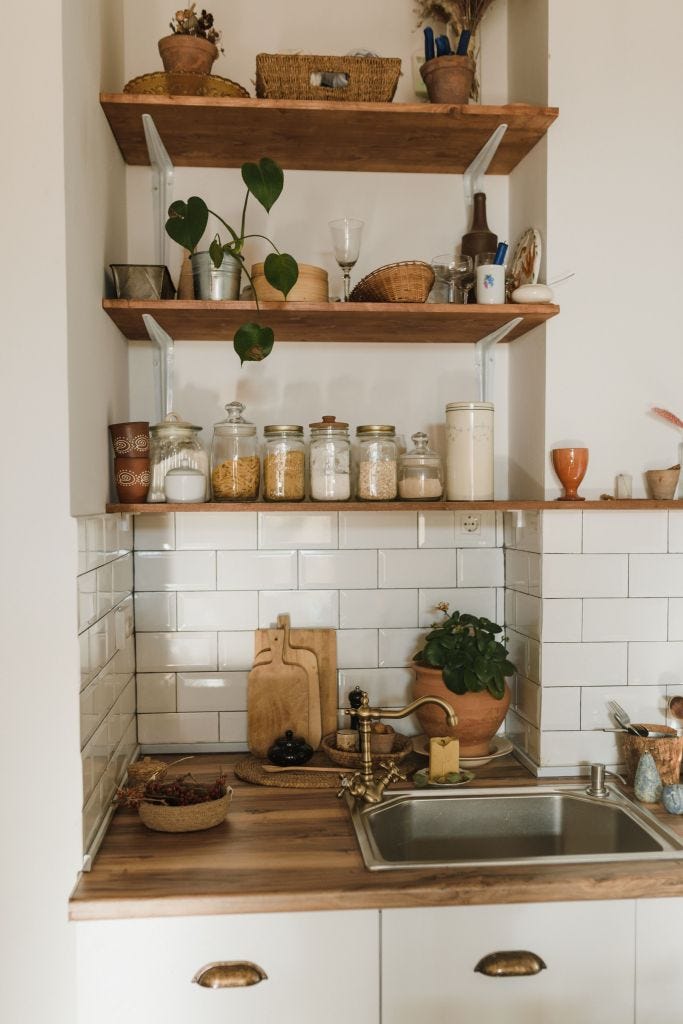
A Full Pantry Is Not the Same as a Supportive One
Let’s begin here, because this is where so many of us quietly lose ourselves. A full pantry can look comforting. Rows of tins. Bags of grains. Pastas, sauces, spices, and six different kinds of flour you bought with great intentions. From a distance, it can feel like evidence of a woman who has her life together. But full isn’t the same as functional. Sometimes full just means crowded.
A supportive pantry asks different questions. Not: “What should a proper pantry contain?” But: “What do I actually cook? What does my body need right now? What meals help me feel steady? What do I reach for when I’m tired and can’t be bothered to think?”
That shift, from performing a well-stocked life to genuinely supporting your real one, is one of the quieter reinventions of midlife. You stop buying a fantasy version of your week. You start building for the one you’re actually living with.
A full pantry is often built around who you think you should be. A supportive pantry is built around who you are. And midlife, if nothing else, is a season for that kind of honesty.

Build It Around How You Actually Cook
One of the most loving things I’ve learned to do for myself in recent years is to stop designing my kitchen around an imaginary version of my life.
You know her. The woman who makes a different recipe every evening, uses all the herbs before they wilt, always has a lemon, never forgets to defrost things, and has fresh stock cooling on the hob while she simultaneously finishes a chapter and answers three emails. She is wonderful. She does not live here.
Most of us cook in patterns. We have five or six meals we return to because they work, because they comfort us, because they fit the shape of our evenings, because they don’t ask too much. And there is nothing wrong with that. There is, in fact, something quietly wise about it. Those are your anchor meals. The ones your body knows and trusts.
For me, it looks like eggs on sourdough, scattered with seeds and something green. A nourish bowl made from whatever’s already cooked. Dhal with rice. Falafel with garlic and coriander flatbread, served with yoghurt and za’atar. Mac & Cheese. Soup, almost always soup. A jacket potato with tuna and a handful of salad thrown alongside it with genuine ease. Simple food, made with care, eaten at the coffee table with the candle lit because that’s the ritual, and I refuse to let it slide.
Those meals are where I’d build my pantry. And that’s where I’d tell you to build yours. Not around the aspirational recipes. Not around the complicated, impressive ones you’ll make when life calms down. Around the meals that already appear in your week. Because those meals are telling you something. They’re showing you exactly what your real life needs; you just have to be honest enough to listen.
Start With Your Ten Real Meals
Before you buy a single thing, do this: write down ten meals you actually make. Not ten meals you wish you had made. Not the impressive ones, the healthy ones, or the ones from the recipe you saved in October. Ten real meals. The ones that keep appearing. The ones you reach for on tired evenings. The ones that make you feel like yourself again.
Your list might look something like:
Scrambled eggs on sourdough with avocado and tomatoes.
Greek yoghurt with berries, seeds and a drizzle of honey.
Lentil dhal with rice and spinach.
Chicken soup with whatever’s left in the fridge.
Jacket potato with tuna or cottage cheese and a simple salad.
Roasted vegetables with salmon and tahini.
Pasta with olive oil, garlic, greens, and a tin of tuna.
A nourish bowl built from cooked grains and whatever protein I have.
Bean chilli with sourdough.
Porridge with cinnamon, flaxseed, berries, and nuts.
None of it is particularly complex. All of it is nourishing, real, and honest.
Now look for the repeated ingredients. Those are your staples. Not someone else’s list taken from a cookbook or a wellness blogger with a beautiful kitchen and three hours of free time. Yours. The one that reflects your actual life.
That is where your pantry begins.
The 10-Recipe Kitchen: A Midlife Version

There’s a kind of magic in knowing ten recipes deeply, not just because they’re easy, but because they feel like home, flexible, nourishing, and aligned with you in this season of midlife and menopause. When your hormones shift, your energy fluctuates, and your taste buds sometimes change, having a trusted kitchen foundation becomes a lifeline.
When we talk about nourishing ourselves in midlife, we aren’t just talking about ingredients; we are talking about rhythm. We are talking about how we organise our days so that feeding ourselves feels like an act of devotion rather than another chore on an endless checklist.
This is precisely where the architecture of your kitchen meets the physical tools that keep your days grounded. When you map out your meals, your shopping lists, and your weekly kitchen flow, trying to hold it all in your head is a fast track to mental exhaustion.
This is why pairing your seasonal kitchen curation with a dedicated planning companion, like The Head Plan Meal Planner, changes the texture of how you eat. Think of it not as a rigid diet log or a punishing schedule, but as a gentle roadmap for your nourishment. It allows you to map out your weekly rhythms so you aren’t staring blankly at the fridge at 6:00 PM wondering how to feed yourself well, keeping your favourite grounding recipes in one place, and aligning your shopping with your actual life so your pantry stays stocked with what serves your body right now.

The Four Zones of a Supportive Kitchen
Once you know your real meals, you can build the system around them. I think of my kitchen in four parts, not rigid categories, just a gentle structure. Enough to make nourishment easier without making it a project.
The dry pantry. Your everyday foundations. The things that turn “there’s nothing to eat” into “Actually, I can make something.” For midlife women particularly, I’d anchor this around real-food staples that support steady energy, hormonal balance, and good digestion: oats, rice, lentils, chickpeas, tinned tomatoes, tinned fish, nut butters, seeds, nuts, olive oil, stock, tahini, pasta, quinoa or couscous, coconut milk, apple cider vinegar, dark chocolate, and herbal teas. These are the quiet ingredients. They don’t demand attention. They simply hold the week together.
The fridge. Where nourishment becomes immediate. Eggs. Greek yoghurt. Cottage cheese. Cooked chicken. Leafy greens. Avocado. Berries. Lemons. Fresh herbs. Hummus. Tzatziki. Sauerkraut. Prepped salad. Leftovers. A wedge of cheese that earns its place. Your fridge doesn’t need to be abundant. An overstuffed fridge often creates the same problem as an overstuffed pantry: visual noise, wasted food, and decision fatigue. It should feel like a gentle invitation, not a cold cupboard of guilt.
The freezer. Your margin. Midlife women need margin. We need breathing space, options for the days when the body has quietly said no. A freezer that works for you might include frozen berries, frozen spinach, frozen peas, fish portions, chicken, homemade soup, cooked lentils, batch-cooked rice, smoothie ingredients, and sourdough. This is not laziness; it is wisdom. The freezer says, “I thought of you before you were tired.” That’s self-care in its most practical and unglamorous form, which is, I would argue, the only kind that actually lasts.
The flavour shelf. Where cooking becomes personal. Because nourishment is never just nutrients. It’s also a pleasure. Memory. Culture. Scent. The particular smell of cumin hits you as you walk past a warm pan. The way cinnamon in oats feels like comfort and not just breakfast. Sea salt, black pepper, cumin, coriander, turmeric, paprika, cinnamon, ginger, chilli flakes, garam masala, garlic powder, bay leaves, vanilla. Lemon juice, mustard, soy sauce, tahini, harissa, pesto, olives. This is the part of the pantry that makes simple food feel alive. A bowl of lentils becomes grounding with cumin and turmeric. Greek yoghurt becomes a sauce with lemon, herbs, salt, and olive oil. Roasted vegetables become something close to sensory poetry with paprika and a drizzle of tahini. This is where food stops being functional and starts becoming ritual.
Fridge Therapy: How Small Shifts in Your Kitchen Reflect Deeper Balance

Your fridge is a mirror of your energy, priorities, and what you’re feeding — not just your body, but your rhythms, your peace. Especially now, when life’s changing, your hormones are shifting, and the small acts matter more than ever.
Build for Tired Days, Not Perfect Ones
A pantry that only works when you have energy is not a supportive pantry. It’s a decorative one. Your kitchen should be able to hold you on the days you cannot be bothered. The days when perimenopause has interrupted your sleep for the third consecutive night, and your body feels like it belongs to someone else. The days when your mood is flat and your patience is thin, and cooking feels less like self-care and more like a task you don’t have the bandwidth for.
On those days, you need low-friction meals. Not recipes. Not processes. Assembly. The kind of meal you can make in twelve minutes while half-present and still eat with some sense of dignity and nourishment.
Eggs on toast with avocado and a pinch of chilli. Greek yoghurt with a handful of berries and whatever seeds are in reach. Soup from the freezer with sourdough. A jacket potato with tuna and salad leaves dressed with olive oil and lemon. Couscous with chickpeas, crumbled feta and fresh herbs. Pasta with olive oil, garlic, a tin of tuna, and whatever greens you have. These are not lesser meals. These are lifeline meals.
There’s a strange and persistent pressure in wellness spaces to make every meal an occasion. Every plate is photogenic. Every dinner a statement of how well you’re looking after yourself. But real nourishment is often quieter than that. A bowl. A spoon. Food that steadies your blood sugar, softens your nervous system, and reminds you that you deserve to be cared for.
Even by yourself. Especially by yourself.
Feeding Yourself with Grace: Midlife Nutrition Guide

I was nearing 47 when a tender realisation struck me: I was feeding my body habits I’d outgrown, lattes, late dinners, hurried breakfast bars, drive-through lunches. Busy didn’t mean nourished. I was hungry, not for convenience, but for true nourishment.
Stop Buying for the Woman You Think You Should Be
This part matters, and I want to say it gently but without softening it into meaninglessness. A supportive pantry is not only about what you add. It’s about what you finally stop buying.
