

There are moments in midlife when the noise becomes almost impossible to ignore. You can be making breakfast, driving somewhere familiar, answering a message, or standing in the shower, and suddenly find yourself wondering, Is this really my life?
Not because everything is necessarily falling apart, but because something inside you has become quieter than the life you have been living, and you can finally hear it. The roles that once gave you a sense of certainty may no longer fit in quite the same way. The things you once chased may not matter as much. Your body may be changing, your relationships may be shifting, your children may need you differently, your career may be asking different questions of you, and somewhere beneath all of that there can be a strange, tender feeling that you are meeting yourself again.
We often call this a midlife crisis, but I wonder whether crisis is always the right word. Perhaps sometimes what we experience as crisis is actually the moment when the structures we have built our identity around begin to loosen. The woman who spent years being the dependable one, the good daughter, the devoted mother, the successful professional, the partner, the carer, the one who could always cope, begins to wonder who she is when those identities no longer tell the whole story. It can feel disorienting because we have been taught to build our lives around becoming someone, and suddenly we are being invited to simply be.
This is where mindfulness becomes so interesting to me. Not mindfulness as another item on the self-care list, another thing we should be doing correctly, or another way of trying to make ourselves calmer and more productive. I mean mindfulness as the simple act of becoming present enough to notice what is already here. To pause before automatically reacting. To notice the thought without immediately believing it. To feel what is happening in the body without rushing to change it. To become curious about the woman underneath all the noise.
And that is why, for World Mindfulness Day, I wanted to explore this subject through a conversation with Awakened Zen Master Thich Dieu Thien.
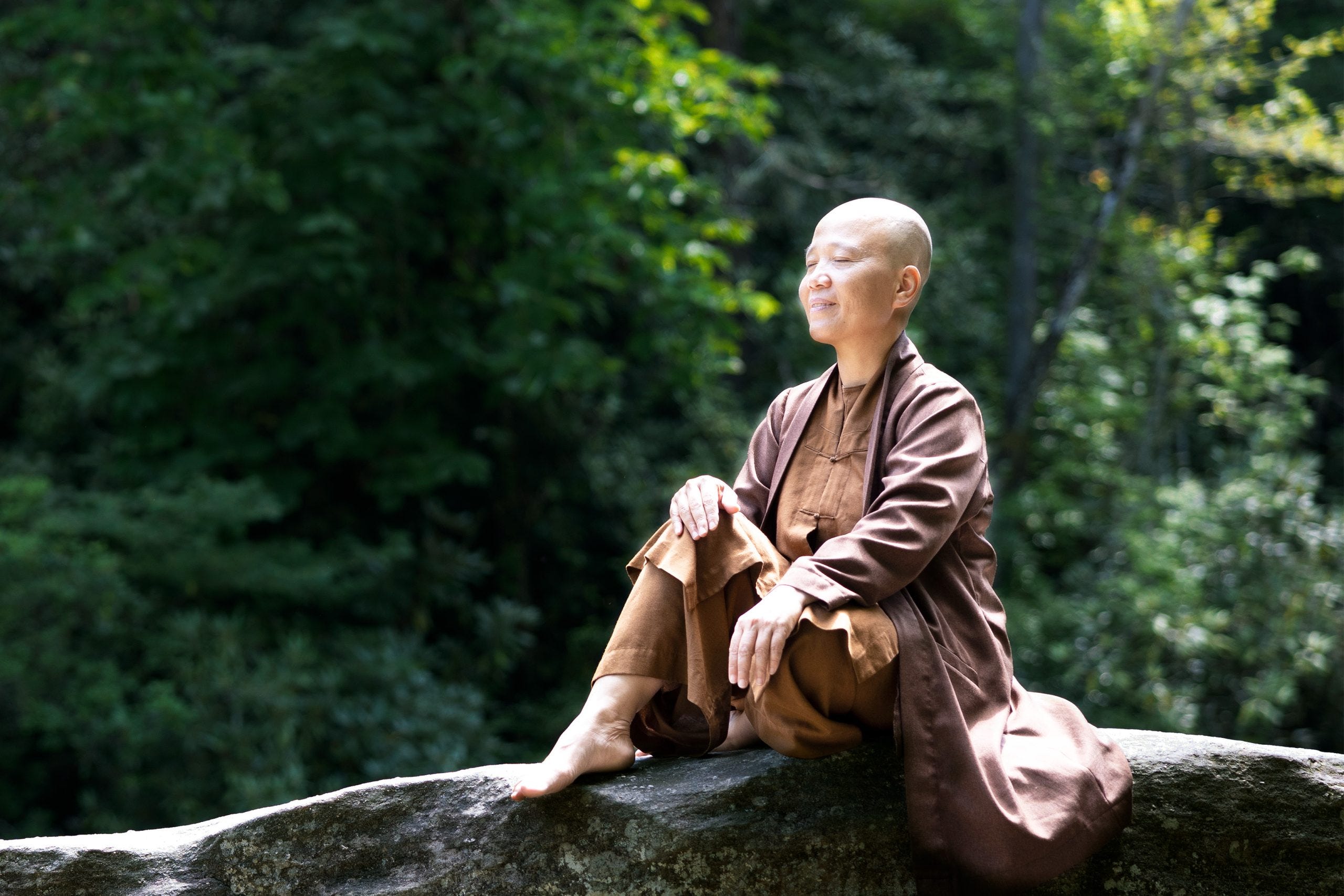
Her understanding of awareness reaches far beyond the kind of mindfulness we might ordinarily associate with meditation apps, breathing exercises, or finding five quiet minutes in a busy day. Her own journey began with a profound question about existence that arose when she was very young: where do beings come from, where do they go, and is there anything beyond the cycle of birth and death? She describes knowing that she belonged to what she calls Awakened Home, the timeless Source of Awakening, and that this knowing shaped the direction of her entire inner life.
By the time she was 30, that question had become so fundamental that she could no longer remain where she was. From the outside, it might look like an extraordinary act of courage, leaving behind studies, safety, and a familiar life. But she describes it differently. It wasn’t really a decision to leave. It was the impossibility of remaining still when the question of existence had reached such depth.
There is something about that distinction that feels strangely familiar when we think about midlife. Sometimes we tell ourselves we have chosen change, when the truth is that something within us has become impossible to ignore. We can spend years adapting ourselves to circumstances, keeping the peace, doing what is expected and making the best of things, until eventually the old way of living begins to feel too small. The question isn’t necessarily What should I do next? Sometimes it is simply, What is this discomfort trying to show me?
The Moment Everything Changed
Thich Dieu Thien’s own awakening came during a ten-day retreat in Thailand. On the eighth day, her attention was not focused on having an extraordinary experience, but on directly penetrating what she describes as the house-builder, the mechanism responsible for the cycle of birth and death. She encountered it through desire, fear, praise, and the construction of self-identity, but rather than avoiding or resisting these experiences, she continually turned attention back towards their source. In the moment of awakening, she describes the house-builder collapsing completely, with the structures of ignorance dissolving and the distinction between seeker and what was being sought falling away.
Now, that may sound far removed from the woman sitting at her kitchen table wondering what on earth she is doing with the second half of her life. But there is a thread connecting them, and it is the question of identity. Who am I beneath everything I have been told I am? Who am I beneath the roles I perform, the expectations I carry, and the stories I have repeated about myself for years?
When I asked Thich Dieu Thien where a woman in midlife should begin, her answer was beautifully simple. She said the beginning isn’t about adopting a new belief system, but about pausing long enough to notice that there is already an awareness present within every experience. Behind all our roles and responsibilities, there is a knowing presence that is untouched. To recognise this isn’t to become somebody else. It is to recognise what has never left.
I love the simplicity of that because midlife can so easily become another project. We decide we need to reinvent ourselves, discover our purpose, create a new morning routine, fix our mindset, lose the weight, build the business, find the relationship, travel more, meditate more, and somehow emerge as this beautifully upgraded version of ourselves. There is nothing inherently wrong with wanting change, of course, but there is a danger in believing that our salvation is always somewhere ahead of us.
What if the invitation is sometimes to stop searching quite so hard?
The Weight We Carry
Think about how many years you may have spent carrying things for other people. Perhaps you’ve been the one who remembers everyone’s birthdays, organises the appointments, keeps the family moving, manages the emotional temperature of the room, earns the money, makes the decisions or simply keeps going when you are exhausted. For many women, particularly as they move through midlife, giving, caring and responsibility have become so deeply woven into identity that it becomes difficult to separate what we do from who we believe we are.
Thich Dieu Thien describes this beautifully when she talks about emotional weight. She suggests that what we call weight is not necessarily life itself, but our identification with roles, memories, and the image of I am the one carrying this. The activity itself may not disappear. Life may not suddenly become easier. But when we begin to see the identification clearly, the sense of a separate self who must carry everything can begin to loosen. In that space, she says, natural stillness reveals itself.
That feels like an important distinction for midlife women. Letting go doesn’t always mean leaving your job, ending a relationship, moving house, or dramatically changing your life. Sometimes letting go is much quieter. It might mean releasing the belief that you have to be the strong one all the time. It might mean noticing how often you say yes when you mean not today. It might mean allowing somebody else to be disappointed in you. It might mean recognising that a version of yourself you worked very hard to become is no longer the woman you want to be.
And perhaps mindfulness gives us the space between the old pattern and the new choice.
When Midlife Feels Like a Crisis
One of the questions I most wanted to ask Thich Dieu Thien was whether midlife crisis could itself be an invitation. Her answer made me pause.
She explains that midlife can feel like a crisis because the structures that once supported identity begin to dissolve. Roles, achievements, and external validation can lose their former stability, and a deeper uncertainty emerges. But from the perspective of awakening, she says, this isn’t merely loss. It can also be a sign that identification structures are loosening, creating an opening to return to what has never changed.
Perhaps that gives us another way to look at the strange territory of midlife.
Maybe the question isn’t, How do I get back to the woman I used to be? Maybe it is: What if I don’t need to?
There can be grief in becoming someone new. There can also be extraordinary freedom. We don’t have to keep proving that we are the woman we were at 30. We don’t have to keep performing an identity simply because other people have become accustomed to it. We can allow ourselves to become quieter, more discerning, more honest. We can notice what feels true now.
That is not giving up; that is paying attention.
Suffering, Searching and the Woman Who Is Tired
We also spoke about suffering, and this may be one of the most challenging ideas in the interview. Thich Dieu Thien describes liberation from suffering not as changing every difficult circumstance, but as seeing the mechanism that creates the sense of I am suffering. When awareness turns towards that process, suffering is no longer sustained in the same way by identification. The experience may still arise, but it is seen as something moving within awareness rather than as the entirety of who we are.
This isn’t about dismissing pain or pretending difficult experiences don’t matter. It is a much deeper invitation to look at the relationship we have with our experiences. There is a difference between saying I am exhausted and noticing exhaustion is here. There is a difference between saying I am broken and noticing the thought that says I am broken. There is a difference between believing I have lost myself and becoming curious about the awareness that is noticing the feeling of being lost.
And perhaps that is why her final answer stayed with me most.
I asked what she would say to a woman who is tired and searching. Her answer was not another list of things to try. She didn’t offer another path, another belief, or another destination. Instead, she invited that woman to pause long enough to notice that even the searching itself is being known clearly. Within exhaustion and questioning, there is already a presence that is aware of everything. What is being sought, she says, is not ahead. It is the very ground of knowing here and now.
There is something incredibly tender about that.
Because how many of us have spent years searching for the answer that will finally make us feel whole?
Perhaps the next book will tell us. Perhaps the next course. The next relationship. The next holiday. The next career move. The next version of our body. The next achievement.
And perhaps, every now and then, the most loving thing we can do is stop.
Take a breath. Feel our feet on the floor. And simply notice that we are here.
A Different Way of Entering Midlife
Mindfulness may not solve midlife. It isn’t supposed to.
It won’t stop our bodies changing or prevent relationships from ending. It won’t give us back the people we’ve lost or guarantee that the future will unfold exactly as we hope. What it can offer is a different relationship with the moment we are actually living.
It can give us the space to notice before we react, to feel before we fix, and to question the stories we have spent years accepting as truth. It can remind us that we are more than the roles we perform and that there is something deeply valuable about becoming still enough to hear ourselves beneath them.
Perhaps this is what Thich Dieu Thien means when she speaks about returning to Awakened Home.
Perhaps home isn’t somewhere we have to travel towards.
Perhaps it is something we learn to recognise.
And maybe midlife, for all its uncertainty, is one of the seasons in which we become ready to recognise it.
If this piece stayed with you, don’t rush past it. Let it settle.
You can take this further inside The Midlife Circle, where I share more personal reflections, deeper conversations, and gentle guidance to help you live this chapter with more clarity, intention, and ease.
