

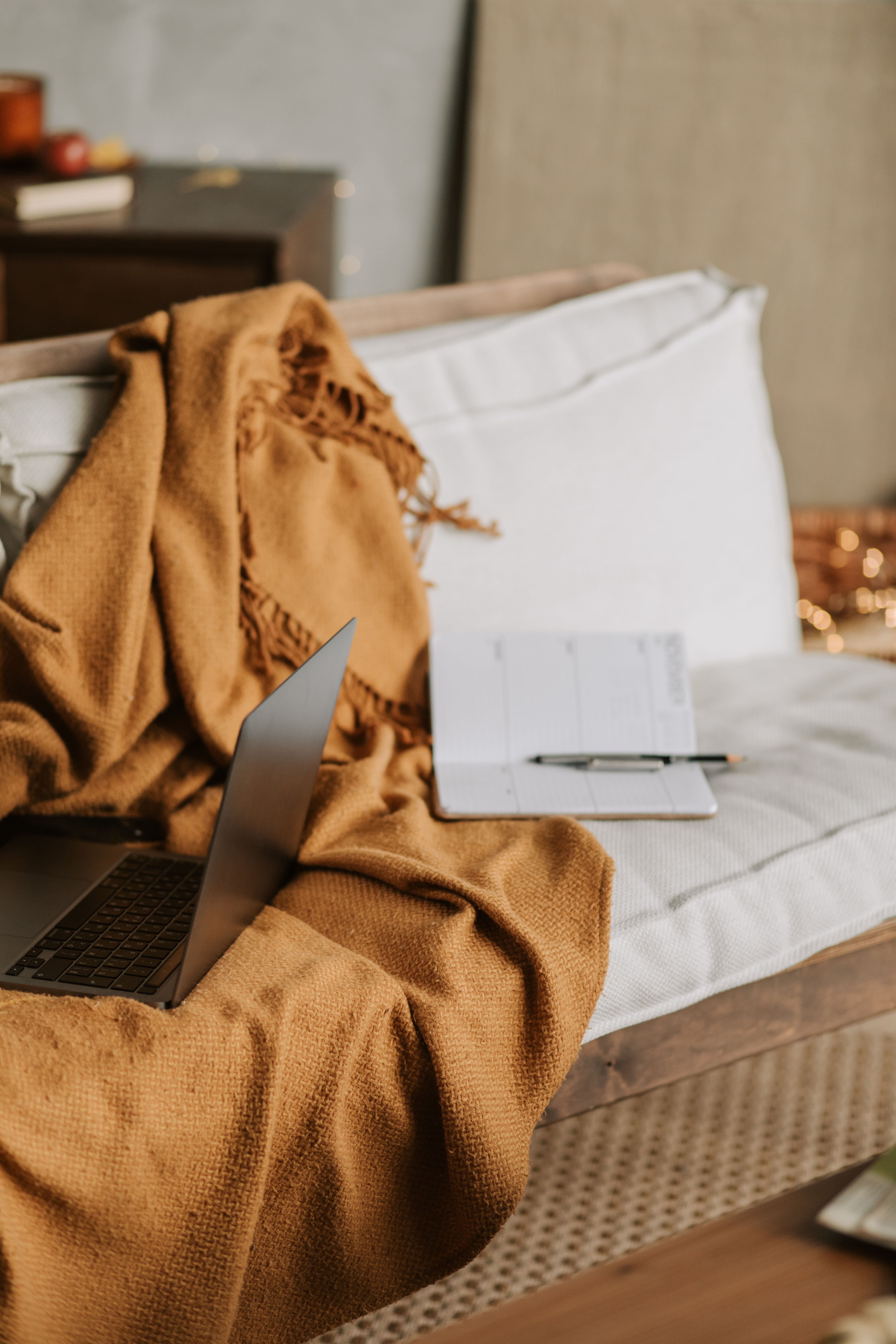
It’s a cool, quiet evening, the kind where our home feels almost too still. I’m curled into the corner of the sofa in my soft grey cashmere cardigan, a cup of chai going down nicely on the coffee table, the candle on the vintage bureau throwing that small, flickering light across the room. I’d put on a YouTube video almost absentmindedly, something to half-listen to while I did very little else. Simon, talking through Greg McKeown’s Essentialism, the 80/20 principle, the slow discipline of clearing your physical space and your digital one.
I’d heard the book mentioned a dozen times over the years. I’d nodded along, the way you do, filing it under things-I-already-basically-know. But this time, something in me went very still, in a different way from the sofa-stillness. The kind of still that happens right before you admit something to yourself.
Because I have spent six years of my life clearing.
Not in one dramatic weekend with bin bags and a podcast playing too loudly to drown out the doubt. Slowly. Room by room, drawer by drawer, year by year, until I looked up recently and realised I’d let go of around 90% of everything I once owned.
Ninety per cent.
I say that number out loud sometimes and watch people’s faces do a small double-take, as if I’ve told them something slightly improper. And maybe I have. We’re not really taught to talk about how much we’re willing to lose, only how much we’ve managed to gain.
I don’t have a junk drawer. Not one. No drawer of dead batteries, orphaned cables, and birthday candles from three birthdays ago. I used to think that was the goal, the finish line, the point at which you could finally exhale and call the work done.
It isn’t. That’s the part nobody quite tells you.
Even with 90% gone, I still have more than I need. Decluttering, it turns out, isn’t a single brave afternoon. It’s a relationship. An ongoing, slightly uncomfortable, deeply clarifying conversation with everything you own, one you have to keep having, because the things that earned their place last year aren’t automatically entitled to keep it forever.
So every few months, I go through it all again, and the question gets sharper each time. Not “Do I use this?” Not “Could I justify keeping this if someone asked?”
But “Does this still add value? Does this still bring me joy?”
There’s a particular kind of grounding that comes from this, one I didn’t expect when I started. It isn’t really about having less in the way people imagine, the bare shelves, the stark white walls, the performative emptiness. It’s about presence. It’s standing in a room and actually seeing what’s in it, instead of looking past a decade of accumulated almost-stuff to find the handful of things you actually love.
And here’s what I’ve come to believe, somewhere in the middle of all this letting go: the things that remain need to earn their place properly, not just survive the cull. I don’t want a home full of things I merely tolerate, the fine, the acceptable, the it’ll-do. I want what’s left to genuinely delight me. The candle that makes the whole room smell like something is about to happen. The lotion that feels like a small ceremony rather than a chore. The teacup that makes the tea taste better, somehow, even though I know logically it doesn’t.
A decluttered life filled with things you merely put up with isn’t essentialism. It’s just a quieter, smaller pile of clutter, dressed in better lighting.
I think about this in terms of money, too, more than I used to.
Living within your means is talked about as a punishment, the consolation prize for women who didn’t manage to earn enough to live any other way. I don’t experience it like that anymore, and I want to be honest about how long it took me to stop. Living within my means, now, feels like the opposite of small. It feels like control. It feels like deciding, in advance, what my money is actually for, so it stops quietly leaking out of my life on things that were never going to move me an inch closer to anything I actually want.
A budget was never meant to be a cage. It’s a filter. It’s me, deciding what’s essential, before a sale, a scroll, or a moment of low self-worth gets to decide for me.
And the upgrades that have changed my life the most haven’t cost me anything to buy. They’ve cost me something to release. Paying off debt and feeling, for the first time in years, like I didn’t owe a single person or institution a single thing. Choosing work that means something to me, rather than work that simply, exhaustingly pays. Clearing physical clutter and noticing, almost as a side effect I hadn’t gone looking for, that my mind had gone quieter too, as though the chaos had never really been about the shelf in the first place.
Clutter doesn’t stay where you put it. It follows you into your thinking. Into your sleep. Into the soft, private parts of you that decide what feels possible and what doesn’t.
I think that’s why the digital side of all this has felt so much louder, even though none of it takes up a single inch of physical space.
I’ll tell you the part I haven’t shared in a while, because it matters.
Facebook suspended my personal profile. Then my business profile. Then, almost as an afterthought, all three of my Instagram accounts. No warning. No real explanation, just the particular silence of a platform that doesn’t owe you one. One morning, they were there, the way they’d been there for years, a record of a decade of my life and work. The same evening, gone.
I want to tell you I was devastated. That would be the expected response, wouldn’t it? The appropriately tragic note to hit. But the truth is messier and, I think, more useful than that.
I’d been quietly thinking about walking away from all of it myself for a couple of years. Quietly is the important word there. I never said it out loud, not even to myself in the mirror, because there was always a reason to stay. Remain connected with family and friends (I never spoke to anyone). A launch to promote. An audience I’d convinced myself I couldn’t survive without. A version of visibility I’d been taught to chase long before I ever stopped to ask whether it was actually serving the work, or just the fear underneath it.
So when the decision was taken entirely out of my hands, something in my chest didn’t clench. It loosened.
It felt like a blessing in disguise. The kind of permission I clearly hadn’t trusted myself enough to give, arriving anyway, wearing the costume of a setback.
I deleted my Twitter account shortly after that, on my own terms this time, with both hands and no hesitation. And then TikTok, an account I hadn’t opened in five years, which might be the single most honest example of the 80/20 principle I can offer you. An app contributing precisely nothing to my life, sitting there, untouched, simply because deleting it had never quite made it to the top of any list.
What I noticed, once the dust properly settled, wasn’t only that I had more time. It was that my own thinking had gone quieter. Less of that low, constant hum of comparison, that background static of everyone else’s life, everyone else’s pace, everyone else’s apparent certainty, that platforms are built to generate, whether you’re posting or simply lurking, half-asleep, thumb moving before your brain has caught up to ask why.
Substack and LinkedIn are the places I’ve chosen to stay, and I’ve chosen them on purpose, the way you might choose to keep one true friend after a long, necessary culling of acquaintances. It’s the ones that feel aligned with the actual work, rather than a performance of having one.
I keep thinking about a question, the kind that sits in your chest a while before it fully makes sense.
If something I’d been too afraid to release myself was suddenly taken from me tomorrow, would it feel like devastation, or would some small, secret part of me feel relieved?
Sit with that one. I did, for longer than I expected to.
Where am I keeping something out of habit rather than genuine value?
What would I let go of myself, right now, if I stopped waiting for permission, or for circumstance, to make the decision for me?
Where, exactly, have I been confusing more with better?
Does this belong in my future?
You don’t have to overhaul your whole life this week. Essentialism was never meant to be a sprint, and I’d be lying if I told you mine happened in one tidy weekend. Go through one shelf again, even one you’ve already cleared once. Question a subscription you haven’t thought about in months. Notice the account you keep open out of habit rather than genuine interest, and let it go, deliberately, before life makes the decision for you the way it made mine.
Let your spending reflect what you actually value, not whatever’s easiest to default to at ten o’clock at night.
Less, but better. That’s the whole art of it, and I’m still, even now, learning to practise what I teach.
If this piece stayed with you, don’t rush past it. Let it settle.
You can take this further inside The Midlife Circle, where I share more personal reflections, deeper conversations, and gentle guidance to help you live this chapter with more clarity, intention, and ease.
If you’re feeling the pull to go deeper in a more personal way, you can also explore working with me. And if this resonated, tap the ♡, leave a comment, or share it with someone who might need this today.
Kiran x
kiransinghuk.com | The Sattva Collective
I can relate to this loosening and letting go Kiran. I too have let go of much of my business and live by 'when enough is plenty'. Living within my means as you put it. It's so freeing. Thanks for sharing. Midlife opens the door to these realisations - feminine wisdom. Anita xx