


There comes a moment in midlife when speed starts to feel suspicious. Not because ambition disappears. Not because we suddenly have nothing left to build, become, desire, or be undone by. But because the pace that once kept us feeling accomplished now feels like it is quietly stealing from us.
Our mornings. Our softness. Our nervous system. Our ability to notice the life we worked so hard to create, even as we are standing inside it.
I’ve been in love with Japan for years. Long before it became a wellness trend, long before everyone started buying matcha sets and rearranging their bookshelves into something more minimal and more photogenic. My love for it began in the pages of books. L’art de la Simplicité by Dominique Loreau, who lived in Japan for years and wrote about simplicity with an elegance I had never quite encountered before. Then Zen: The Art of Simple Living. Then Wabi Sabi. Each one arrived at exactly the right moment, when I was quietly outgrowing something and hadn’t yet found the language for what I was growing into.
I’d sit with those books the way you sit with a person who finally says the thing you’ve been feeling for years but couldn’t find the words for. That particular exhale. That sense of: oh. There it is.
Japan, to me, has always felt less like a country to visit and more like a philosophy to live by. A different relationship with time. With beauty. With the ordinary. With ageing. With the self. And for women in midlife, especially those navigating perimenopause, menopause, or what the Japanese call Kōnenki, this doesn’t feel like lifestyle inspiration. It feels like a quiet homecoming.
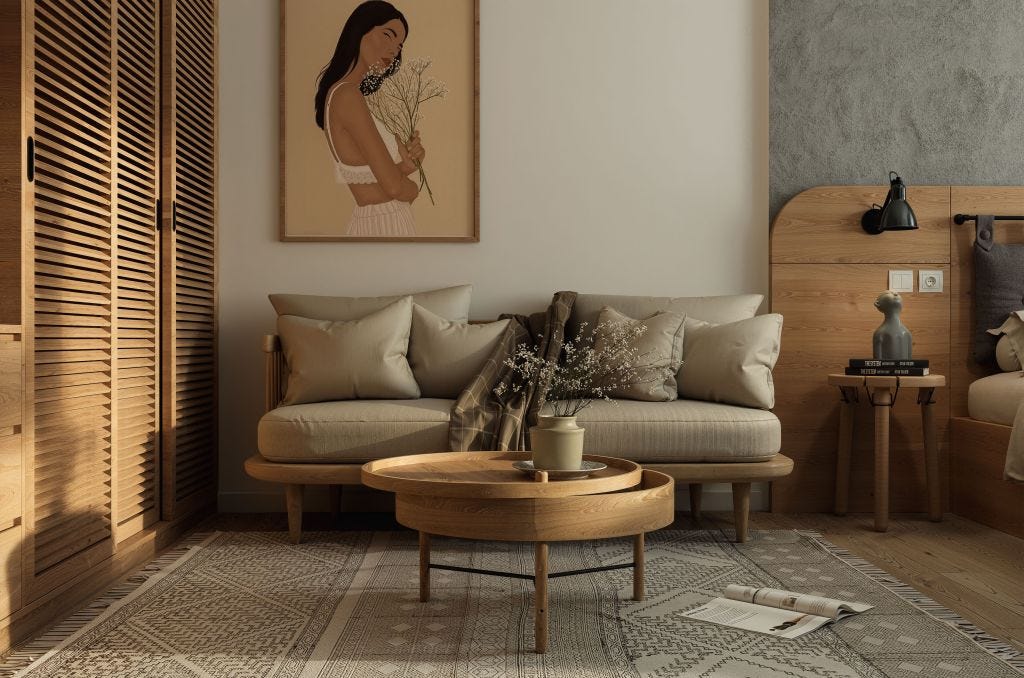
Slow living is not doing less. It is living with more presence.
Here’s the thing I keep coming back to. Most women I know are not exhausted because they are weak. They are exhausted because they have spent decades being everything to everyone, simultaneously, without ever being asked whether that pace was one they could actually sustain.
The daughter who coped. The mother who remembered every detail of everyone’s life while slowly forgetting her own. The partner who adapted. The professional who performed. The friend who checked in. The woman who kept the calendar moving, the emotions contained, and the home running beautifully while her own needs sat quietly in the waiting room, very patient, wondering if their turn would ever come.
Then midlife arrives. Not politely. Honestly. The body starts speaking louder. Sleep becomes sacred. Energy becomes a currency you guard rather than spend freely. Tolerance for nonsense becomes, if I’m honest, almost entertaining in how thoroughly it evaporates. And the old way of living simply doesn’t fit anymore. This is where slow living becomes more than just an aesthetic.
Japanese slow living honours rhythm, ritual, seasonality, craftsmanship, walking, food, nature, simplicity and the particular beauty of what is imperfect or passing. It asks us to stop measuring the value of a day by how much we extracted from it and start measuring it by how much we actually felt. That is a very different kind of wealth. One, I spent the first half of my life not knowing I was hungry for.
The beauty of Ma: making space for your life to breathe
One of the Japanese concepts that stopped me mid-page the first time I encountered it is Ma. The space between things.
The pause in a conversation before you’ve decided what to say. The empty wall in a room that lets everything else breathe. The silence between notes is what makes the music what it is. The unscheduled hour on a weekday afternoon, when nothing is required of you and your nervous system slowly, cautiously begins to unclench.
In the world most of us live in, empty space makes us uncomfortable. We rush to fill it. Another task, another tab, another podcast playing into the silence because the silence asks questions we’re not sure we’re ready to answer yet.
But midlife asks for Ma. Not because we are becoming less capable. Because we are becoming more honest. We need space to hear ourselves again. Space to grieve the things that didn’t happen. Space to feel what was quietly postponed across all those years of doing and producing and holding everything together. Space to ask, slowly, without pressure: who am I now, when I’m not performing any of the roles?
This is not indulgence. This is restoration.
I remember reading in L’art de la Simplicité about the Japanese practice of leaving rooms deliberately unfinished, never quite complete, always with a little empty space held in reserve. Not because of lack, but because of wisdom. Because a life crammed to its edges leaves no room for the unexpected beautiful thing to arrive.
The Book I Keep Going Back To

There is one book I have returned to more times than I can count. Not because I have forgotten what it says, but because, somehow, I always need to be reminded.
I think about that a lot when I’m at my bureau in the morning with my chai still steaming and the candle lit and nothing yet demanded of me. That this, this particular pocket of Ma, is not wasted time.
It is the architecture of everything else.
Kōnenki: the season of change
In Japan, the menopausal transition is called Kōnenki. It translates, roughly, as the change-of-life season. And I love that framing in a way that goes beyond preference, because language is never neutral. The words we use to describe an experience shape how we meet it.
Konenki: My Renewal Years Begin Now

I stumbled across something beautiful recently: in Japan, menopause isn’t whispered about as a decline; it’s called “konenki,” a word that translates to years of renewal, season, energy, growth, and rebirth. That subtle shift in language matters. Instead of decline, it invites us into a different story, a story that celebrates this chapter of life as a …
When we call this stage a decline, we arrive at it with fear. When we call it a failure, we arrive with shame. When we call it an ending, we spend the whole time looking backwards, mourning a season that has simply finished. But when we call it a season of change, something in the chest softens.
Let me be clear: I am not romanticising the symptoms. Hot flushes that arrive uninvited at dinner parties. Night sweats that have strong opinions about your sleep. Brain fog that makes you stand in the middle of a room genuinely unsure what you came in for. Anxiety that surfaces from nowhere at 3 am like an unwelcome houseguest who hasn’t grasped social cues. All of it, real.
But Kōnenki offers a more compassionate frame. The body is not betraying you. The body is communicating with you. It may be asking for a different pace. A different relationship with food. A different kind of movement. A different level of honesty in the relationships you’re maintaining. A different devotion, finally, to yourself.
That is not a decline. That is the most sophisticated form of self-knowledge becoming available to you if you’re willing to listen rather than override.
