


When life moves fast, our homes often absorb the noise. Over the years, clutter accumulates: not just physical items, but the visual and sensory noise of a life lived on autopilot. In midlife, as we begin turning our attention inward, our physical environment becomes a crucial anchor for our nervous system.
Looking to Swedish cabin culture (smultronställe) and Japandi interior philosophy — the harmonious blend of Scandinavian functionality and Japanese rustic minimalism — offers a powerful framework for redesigning our living spaces. Both approaches honour natural textures, clean lines, subtle warmth, and the intentional elimination of excess.
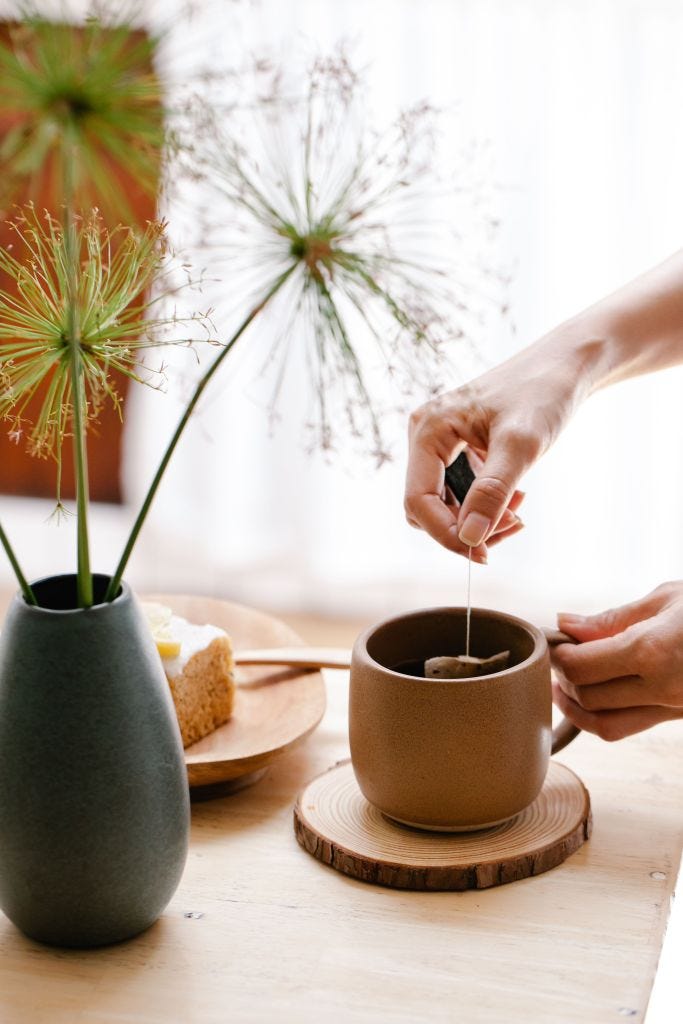
Creating an intentional space isn’t about achieving stark perfection; it is about cultivating a sanctuary that feels restorative. It’s in the quiet ritual of lighting a candle at your desk, sipping chai slowly from a ceramic mug, or introducing subtle, grounding sensory elements like an airyfragrances stone diffuser to gently scent a quiet corner. By paring back the physical clutter and elevating simple, beautiful daily rituals, your home transforms into a place of genuine ease, a true foundation for your next chapter.

Why British Homes Accumulate the Way They Do
Before we talk about editing, it is worth understanding why our homes become what they become.
British homes are not cluttered because we are lazy or undisciplined. They are cluttered because we are sentimental, because we live in relatively small spaces, and because we are extraordinarily good at holding onto things for reasons that feel entirely reasonable at the time.
We keep things for the dinner party that happens twice a year. We keep clothes for the body we had a decade ago. We keep objects inherited from people we loved because letting them go feels like a second loss. We keep things for the woman we might become, the one who uses the pasta maker, reads every book on the shelf, and hosts with the ease of someone who hasn’t been exhausted since 2019.
We are not, in truth, storing objects. We are storing versions of ourselves.
The woman who hosted more. The mother who kept everything. The daughter who couldn’t let go of what belonged to someone she loved. The younger self who wore different clothes, lived in a different season, and had different dreams.
And this is where it becomes important to name something clearly: clutter is rarely just clutter. It is often delayed decision-making. It is often grief. It is often hope. It is often guilt, wearing a cardigan, sitting quietly in the airing cupboard.
By midlife, the home has frequently become a museum of who we have been. The question shifts from “Do I need more storage?” to something considerably more significant: “What am I still carrying that belongs to a life I have already lived?“
That question is not really about interiors. It is about identity. And it is the question at the heart of everything that follows.
The Swedish Concept of Lagom: Enough, Not More
When people think of Scandinavian interiors, they tend to imagine white walls, pale wood, soft textures, and a kind of calm that looks almost suspiciously effortless. But the philosophy underneath Scandinavian simplicity is not about emptiness. It is about enoughness.
The Swedish word lagom translates roughly as “just the right amount.” Not too much, not too little. Considered. Balanced. Enough.
This is a very different concept from the harsher version of minimalism that tells you to strip life bare and live with as little as possible. Lagom asks a softer, more practical question: “What is enough for me to live well?“
Not what looks impressive. Not what proves you are successful, prepared, generous, or stylish. Not what satisfies some external standard of what a well-kept home should contain. Simply: enough for the life you are actually living, with the people who are actually here, in the season you are actually in.
Enough mugs for the people who drink tea in your home. Enough bedding for the beds you actually use. Enough clothes for the woman you are now. Enough beauty to make your home feel cared for. Enough space to breathe.
A Swedish cabin understands restraint, but it also understands comfort and warmth. It does not strip life bare. It removes the noise so the life already present can actually be felt.
This is the part many of us miss when we approach clearing our homes. We assume that less means colder, emptier, less personal. In practice, the opposite is often true. When the excess is removed, the meaningful things become visible. The framed photograph. The ceramic bowl was chosen with care. The blanket you reach for every evening. The chair by the window. These things can finally be seen and felt, rather than lost in the visual argument with everything surrounding them.
Wabi-Sabi: The Japanese Art of Imperfect Beauty
Japanese design brings a different but complementary layer to this conversation. Wabi-sabi is the philosophy of finding beauty in what is imperfect, impermanent, and incomplete. The uneven glaze on a handmade bowl. The table with marks from years of use. The mug that doesn’t match the others but feels exactly right in your hands. The home that shows evidence of being genuinely lived in by someone who chose its contents with care rather than for performance.
This is important because it reframes what a beautiful home actually means. It is not a showroom. It is not a catalogue. It is not a backdrop for content or a display of taste.
A beautiful home, in the wabi-sabi sense, is one that is honest. It honours the marks of time rather than trying to erase them. It allows things to age, to crease, to show the evidence of a life being lived inside them.
For women in midlife, this philosophy can be genuinely liberating. We have accumulated enough experience to know what performative perfection costs. We know the exhaustion of maintaining appearances, keeping surfaces presentable for everyone except ourselves, managing homes as though they were always about to be inspected.
Wabi-sabi asks us to stop. To choose the things that feel true rather than the things that look correct. To let the home be as honest as we are trying to become.
Practically, this means:
The slightly worn table can stay. The old book you return to can stay. The handmade bowl that doesn’t match can stay. The inherited piece that genuinely moves you can stay. What it asks you to release is not the imperfect, the lived-in, or the loved. It asks you to release what is merely kept, out of guilt, habit, obligation, or the vague sense that you should.
Japandi: Where Scandinavian Calm Meets Japanese Soul
Japandi is the design movement that brings these two philosophies together, and the result feels particularly relevant to midlife women designing their next chapter.
On one side: Scandinavian practicality, warmth, light, and function. On the other hand: Japanese simplicity, natural materials, craftsmanship, and reverence for space and imperfection. Together, they create interiors that are quiet, grounded, tactile, and intentional, warm without being cluttered, simple without being cold.
The soul of Japandi is not, despite what the internet may suggest, beige walls and expensive vases with single branches. The soul of Japandi is intentionality. The discipline of choosing less, but better. The wisdom of letting natural materials age. The refusal to fill every corner simply because the corner exists.
For midlife women, this translates into homes that feel like an exhale rather than an obligation. Spaces that reflect who you actually are rather than who you have been performing. Environments that support your nervous system rather than adding to its load.
Natural materials – wood, linen, cotton, wool, ceramic, stone, rattan – ground a space in a way that synthetic surfaces rarely do. Matte finishes, soft textures, and objects that invite touch create an environment that engages the senses gently, rather than overstimulating them.
The goal is not for everything to match. It is for everything to harmonise. There is a meaningful difference.
Why Japan Understands Slow Living So Beautifully, and What Midlife Women Can Learn From It

There comes a moment in midlife when speed starts to feel suspicious. Not because ambition disappears. Not because we suddenly have nothing left to build, become, desire, or be undone by. But because the pace that once kept us feeling accomplished now feels like it is quietly stealing from us.
Why This Matters Particularly in Midlife
Midlife is not just a chronological stage. It is a threshold. For many women, it is the first time in years that a particular question becomes genuinely unavoidable: What do I actually want now? Not what the children need, not what the relationship needs, not what the job requires, but “What do I need, and what kind of environment supports the life I am trying to build from here?”
Our homes often reveal the answer to that question before we are ready to say it out loud. A cluttered wardrobe can reveal a disconnection from the body. A chaotic kitchen can reflect the decision fatigue of a woman who has been making decisions for everyone else all day. An overfilled spare room may hold a postponed dream. A neglected bedroom may show how long she has placed herself last.
This is why home design in midlife is never purely about aesthetics. It is identity work. It is emotional work. It is the nervous system's work. It is the practical, physical expression of asking: “Who am I becoming, and does my environment support her?”
Your home is not separate from your life. It is your life made visible. And creating a home that reflects the woman you are now, not the woman who had to hold everything, not the woman who kept things just in case, but the woman you are actively becoming, is one of the most honest and useful things you can do in this season.
